
Sudan’s Lost Giant: Medieval Cathedral Larger Than the White House Emerges From Desert Sands
Listen to this article
Download the audio (2 MB) — to listen later without a connection
Sudan’s Lost Giant: Medieval Cathedral Larger Than the White House Emerges From Desert Sands
Sudanese-Polish archaeologists uncover a monumental staircase, ancient religious inscriptions, and the original floor of one of medieval Africa’s largest churches.
TNRTPS News | Sudan | November 9, 2026
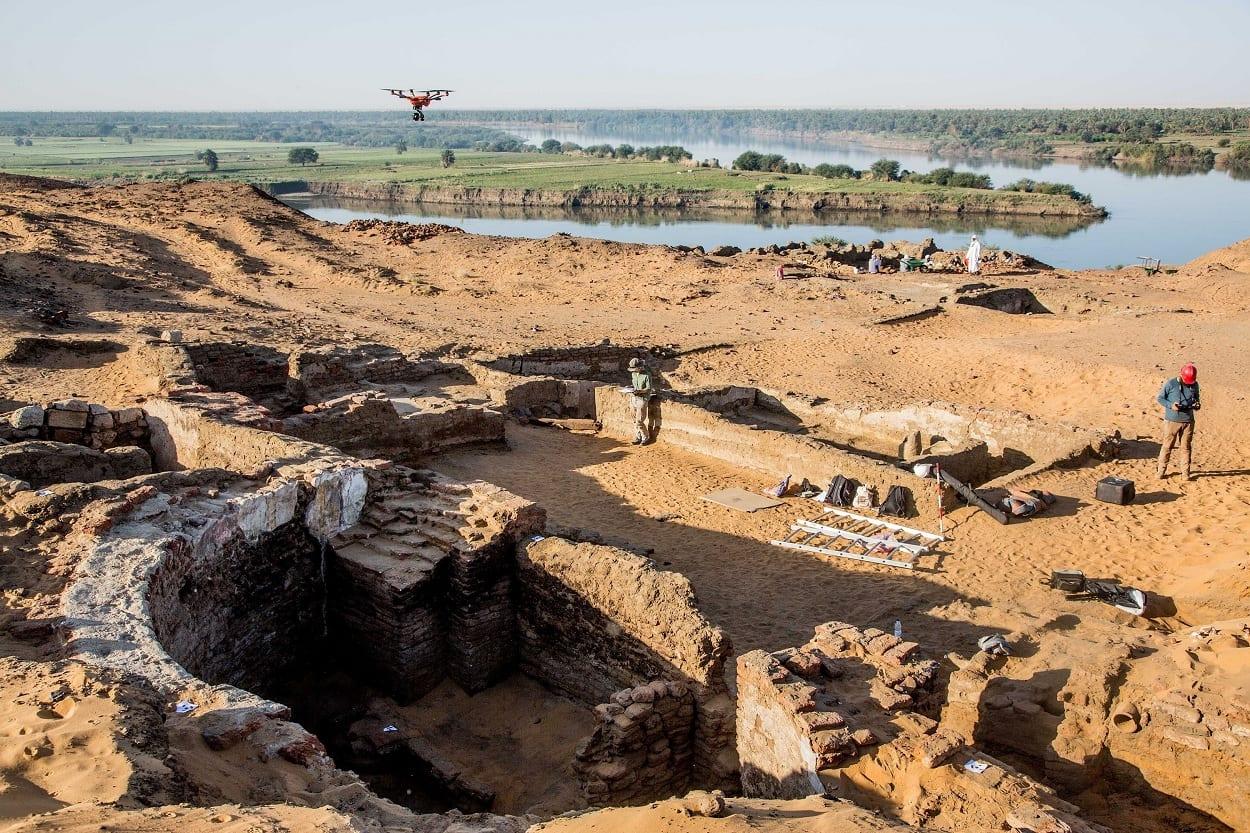
OLD DONGOLA, SUDAN — Beneath the desert sands of northern Sudan, archaeologists are uncovering an extraordinary chapter of African history: a massive medieval Christian cathedral whose estimated dimensions exceed those of the White House in Washington, D.C.
The monument, known as the Great Church of Jesus, stands in Old Dongola, the former capital of the Christian Kingdom of Makuria, which flourished along the Nile during the Middle Ages.
A joint Sudanese-Polish archaeological mission, led by Professor Artur Obłuski of the University of Warsaw's Polish Centre of Mediterranean Archaeology, has revealed new sections of the historic structure.
A Monument Hidden Beneath the Sand
According to researchers, the cathedral measures approximately 47 meters wide and 57 meters long, with an estimated original height of around 21 meters.
The latest excavations have exposed a monumental staircase, structural supports, and, for the first time, a section of the building's original floor.
Some surviving walls reach approximately 11 meters in height, demonstrating the remarkable scale of medieval Nubian architecture.
Although the structure was first identified in 2021, much of the ancient church remains buried. Researchers hope further excavations will establish its full dimensions and historical significance.
Evidence of Sudan’s Christian Civilization
Old Dongola was once a major political, religious, and cultural center of the Kingdom of Makuria.
The archaeological mission has also identified a smaller adjoining church and recovered fragments of painted plaster containing Greek religious inscriptions.
These discoveries provide valuable evidence of the artistic traditions, religious practices, and architectural achievements of medieval Nubian society.
Researchers believe the Great Church of Jesus may have influenced religious architecture across Nubia and potentially other parts of Africa.
A Discovery of International Importance
The cathedral's enormous dimensions challenge common perceptions of medieval African history, revealing the sophistication of a civilization that developed monumental architecture along the Nile centuries ago.
The excavations are being conducted in cooperation with Sudan's National Corporation for Antiquities and Museums.
As archaeological work continues, the site could become an increasingly important destination for historical research, cultural preservation, and future tourism.
Preserving Sudan’s Heritage
At a time when Sudan continues to experience devastating conflict, the discovery offers a reminder of the country's extraordinary cultural and historical legacy.
Protecting archaeological sites, preserving ancient artifacts, and supporting scientific research remain essential to safeguarding this heritage for future generations.
The sands of Old Dongola are revealing more than the remains of a cathedral. They are bringing renewed international attention to a remarkable chapter of Sudanese and African civilization.
Sources: University of Warsaw; Polish Centre of Mediterranean Archaeology; Polish Press Agency; Archaeology Magazine.
Reporting: TNRTPS News Desk
Editorial note: The cathedral's dimensions are archaeological estimates. The comparison with the White House comes from the excavation director and should not be interpreted as a verified comparison of total building floor space.